Jaja to indicate that the previous turn was inadequate
The double particle jaja (yesyes) can have several different functions depending on its sequential position and on its context. One of its functions is projecting an addition which modifies the previous turn while still looking back and showing a degree of affiliation. In the example below, Anne, Lis and Kirsten is drinking coffee, while talking about a firm where some younger people they know, work.
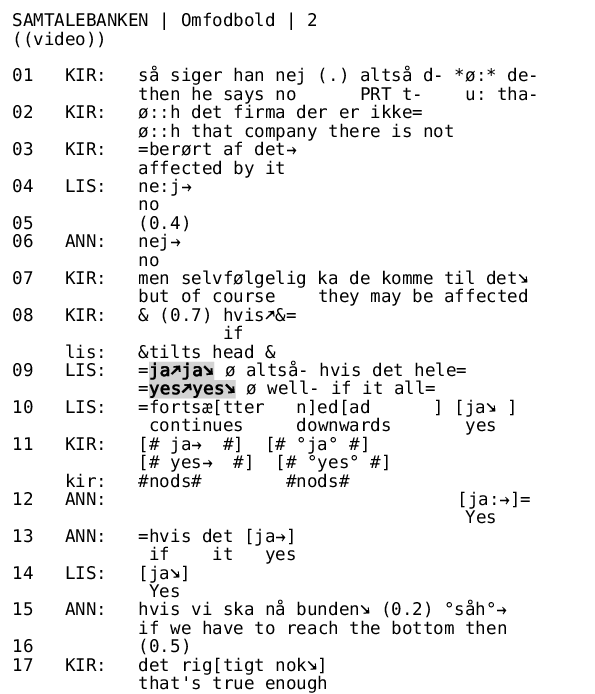
In line 1-3, Kirsten says she has been told the company luckily isn’t affected by the cutbacks, but in line 7 she expresses but of course they can come to it↘.
In line 8, Kirsten hesitates for 0.7 seconds before starting a new turn with if↗. Kirsten is cut off by Lis with yes↗yes↘ ø well- if it all conti[nues d]ow[n. ] [yes↘]. Lis’ yesyes on line 9 does two things: It affiliates with the previous turn, that is, it shows agreement with Kirsten’s statement about the company, but it simultaneously treats the previous turn as inadequate, projecting an additional comment. This additional comment thereby also functions as a condition for Lis’ agreement with Kirsten’s statement.
Sources and further reading:
Heinemann (2009) is a chapter of a book, which accounts for some of the functions of jaja and which has been the starting point for Nielsens (2026 project.
Nielsen (2026) is a bachelor project with thorough analyses of how jaja is used in the different functions accounted for here.
Relevant entries:
The Building Blocks of Talk-in-interaction > Word classes/Parts of speech > interjections/particles
Social Actions > Evaluating actions