Jaja as continuer and affiliation marker
The double particle jaja (yesyes) can have several different functions depending on its sequential position and on its context. One of its functions is as continuer where it signals that the other speaker can continue their turn. In the example below, Beate is telling a story about a party she attended, where she talked with the resident of the apartment where the party was held.
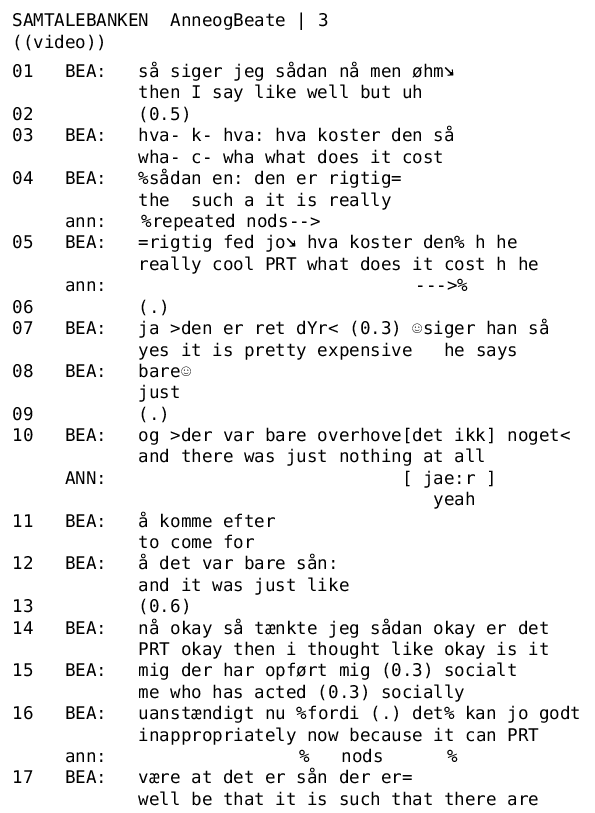
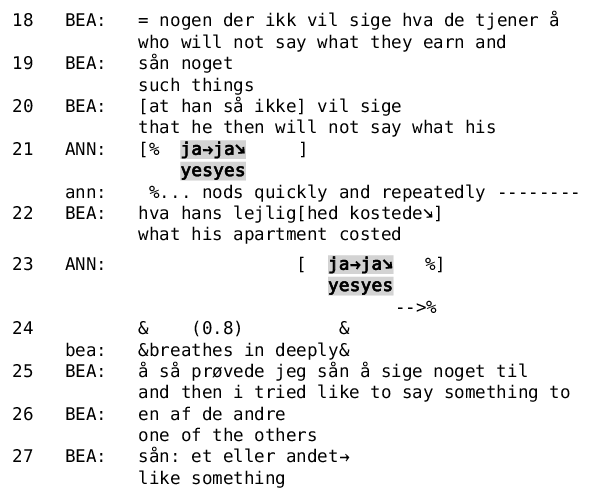
Throughout Beates storytelling, Anne uses nods and utters different forms of yes as continuers, that show that she is listening to the story. In line 14-16, Beate describes how she was afraid she had acted impolitely by saying well okay then i thought like okay is it me=who has acted (0.3) socially inappropriately now=. Anne nods at the same time as Beate produces lines 17 & 20 and says jaja (yesyes) twice in overlap with line 20 & 22. Combined with her continuer nods, Anne’s two jaja’s in line 21 and 23 function as an emphatic suggestion that Beate continue her storytelling. At the same time, they show that Anne understands Beates experience at the party. In other words, Anne affiliates with Beate’s presentation of the situation. Jaja can thus also function as an affiliation marker that shows understanding of or agreement with what another speaker says.
An even clearer example of this can be seen below. Sisse has been working on dyeing Lina’s hair for some time, and she has now finished. Prior to the excerpt they had talked about whether they had enough hair dye.
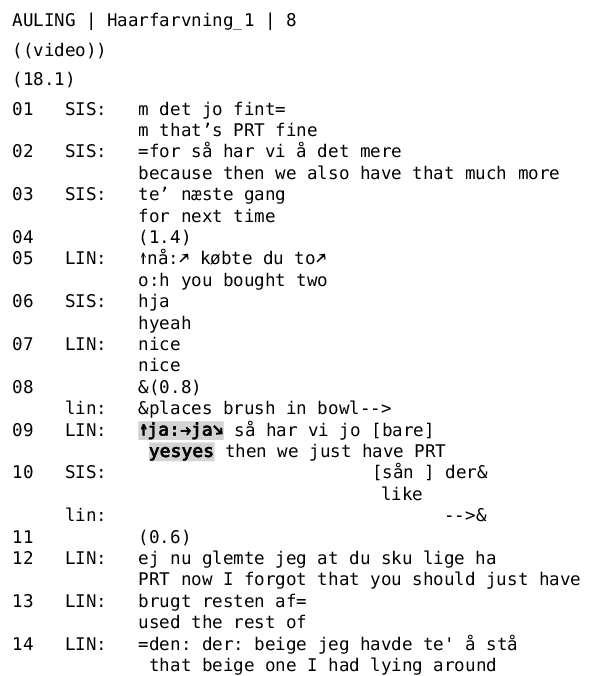
In lines 1-2 Sisse assesses that it is fine that they have more hair dye left because then we also have that much more for next time. After an inserted question-answer sequence in lines 4-6, Lina says yesyes then we just have PRT in line 8. By partially repetating Sisse’s utterance in line 2, she affiliates with Sisse’s positive assessment that they have hair dye left over. So, Lina first says jaja and then begins an assessment that agrees with the stance in Sisse’s assessment. When Lina frames Sisse’s assessment as obvious with jaja, the double particle must be understood as contributing to the expression of agreement. In this way, jaja can show affiliation with the prior turn.
Sources and further reading:
Heinemann (2009) is a chapter of a book, which accounts for some of the functions of jaja and which has been the starting point for Nielsens (2026 project.
Nielsen (2026) is a bachelor project with thorough analyses of how jaja is used in the different functions accounted for here.
Relevant entries:
The Building Blocks of Talk-in-interaction > Word classes/Parts of speech > interjections/particles